
Common Cause Quarterly Events
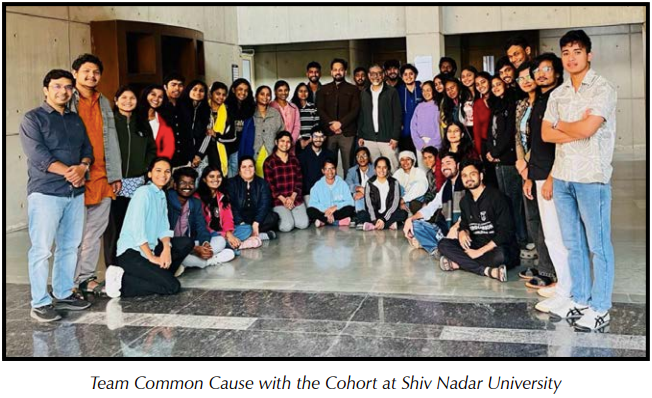
Teaching the Foundations of Justice and Rule of Law: Common Cause at Shiv Nadar University
For the third consecutive year, Common Cause conducted a specially curated Academic course on the rule of law and the system of justice in India for the Master’s Course in Rural Management at the Shiv Nadar University, in November last. Led by Dr Vipul Mudgal, Director, Common Cause, Rishikesh Kumar, Research Executive (Legal), and Sarab Lamba, Researcher with the India Justice Report (IJR), the course covered the foundational concepts of justice, constitutionalism, policing, and institutional reforms.
The course acquainted the students to the Idea of Justice, Ethics, the Constitution, and the Rule of Law, followed by an interactive session on democracy and constitutional conduct. It also had a dedicated session on the Fundamental Rights, Constitutional Rights, and the Basic Structure Doctrine, situating these principles at the core of India’s constitutional identity. Presentations were also made on the four pillars of the justice system—the Police, Judiciary, prisons and Legal Aid—along with key insights from the India Justice Report 2020–2025. A special session was held on domestic violence, followed by animated discussions.
Besides interactive sessions, the students were also taken through video presentations, photo features and case studies of real-life instances involving common people, the police and the justice system.
Conference on Building Justice Capacity
The India Justice Report (IJR); NALSAR University of Law, and the Access to Justice for Prisoners (AJP) jointly organised a national conference, ‘Building Justice Capacity for Tomorrow – Telangana in Dialogue’ on 11th October 2025. The conference, designed as a dialogue between academia, senior policymakers, implementation agencies, active citizens, and stakeholders, was attended by Justice P. Sam Koshy, Executive Chairperson of TSLSA, Dr. Soumya Mishra, IPS, Director General of Prisons and Correctional Services, Justice (retd.) S. Muralidhar, Senior Civil Judge, Mudigonda Raju, Prof. Vijay Raghavan of TISS and Dr. Vipul Mudgal, Director, Common Cause.
Maja Daruwala, Convenor and Chief Editor, India Justice Report, opened the conference, introducing the report and its ranking of states. She pointed to Telangana’s performance over the years, adding that the state had performed consistently well, jumping from No. 11 in 2019 to No. 3 in 2025, highlighting that this is a reflection of governance in the state. Delivering the keynote, retired Justice S Muralidhar said prisons are crowded also due to the excessive misuse of laws such as PMLA and UAPA, and also because judicial officers and police officers are burdened with nonessential duties such as protocol duties and VIP security, instead of focusing on deciding cases in courts, and on law and order and investigation.
Dr Vipul Mudgal made a joint presentation on behalf of the Status of Policing in India Reports (SPIR) and the India Justice Report, focusing on policing in Telangana. He said that the state has consistently performed well to come in first place in the police pillar of the India Justice Report. However, the state shows an underutilisation of the police force, with 1 in 3 constables missing and a shortfall of 13% among officers. He added that the 90% vacancies among scientific staff in Telangana’s forensic labs implied that the department was, in essence, non-functional. Introducing the findings of the SPIR 2025: Police Torture and (Un)Accountability, he added that a significant proportion of police personnel justify the use of torture and violence in the course of their duties, and also believe that they should be allowed to use force without any fear of punishment. The presentations were followed by interactive sessions.
Report on Seminar: “Police Reforms – The Road Ahead”
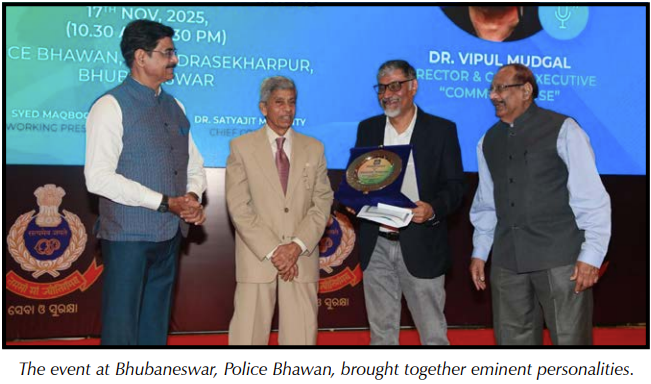
The Bhubaneswar Metropolis Management Association (BMMA) organised a seminar titled “Police Reforms: The Road Ahead” on 17th November 2025 at Police Bhawan, Bhubaneswar. The event brought together eminent personalities from law enforcement, governance, and civil society to deliberate on critical aspects of police reforms in India.
The main speakers of the event included Mr Prakash Singh, the former DGP of Uttar Pradesh and Assam and a former chief of the Border Security Force, Dr Vipul Mudgal, Director of Common Cause, Senior journalist and national security expert, Mr Nitin Gokhle, besides the serving and retired Director Generals of Police from Odisha, several bureaucrats and eminent citizens of Bhubaneswar. Presenting the findings of the latest Status of Policing in India, and the India Justice Report, Dr Mudgal emphasised that reforms in the criminal justice system were vital to achieving the Viksit Bharat.
Focusing on the findings of the IJR regarding the performance of the Odisha State, Dr Mudgal said that it ranked 8th among 18 large and medium states overall, but has slipped in the police pillar from 4th in 2022 to 8th in 2025. While the state consistently meets OBC quotas, it faces significant challenges, such as the rising (21.9%) vacancies for the constables, a significant shortfall of officers (23.6%), and a very high number of missing scientific staff (50%) at the state’s forensic labs. Gender representation at police stations also remained inadequate against the established benchmarks.
He also pointed out that the SPIR 2025 highlighted growing unaccountability of the police concerning custodial violence. It was indeed a matter of concern that about 70% of personnel favoured the power to arrest without court oversight, and 25% justified mob violence in certain cases. He said that the victims of police torture were mostly from the marginalised communities. While the Lawyers were regularly stopped by the police from even entering the police station to assist an accused, the magistrates rarely interacted with arrested persons. Dr Mudgal said that the lawyers and judges felt that the NHRC was not effective in dealing with cases of torture. The program concluded with a vote of thanks by Syed Maqbool Ali, Working President of BMMA.
The event on Police reforms brought eminent personalities together at Police Bhawan, Bhubaneswar
Conference on Justice Delivery Mechanism and Institutional Capacity
On Dec 8th, 2025, Hidayatullah National Law University (HNLU), Raipur, through its Centre for Criminal Law and Jurisprudence and Centre for Law and Human Rights, in collaboration with Centre for Social Justice (CSJ) and the India Justice Report (IJR) organised a national conference on “Justice Delivery Mechanism and Institutional Capacity”.
The University Vice Chancellor Prof V C Vivekanandan, Registrar, Dr Deepak Kumar Shrivastava, senior faculty members, students and a large number of civil society activists from different parts of Chhattisgarh participated in the conference. Presentations were made by Mr Valay Singh, Lead of the India Justice Report, Ms Noopur, managing Trustee of the Centre for Social Justice and Common Cause Director, Dr Vipul Mudgal. The sessions included presentations by Dr Upneet Lalli, Deputy Director, the Institute of Correctional Administration, Chandigarh, and Mr Sunil Gupta, Author of the Black Warrant series.
Common Cause at RTI Mela 2025
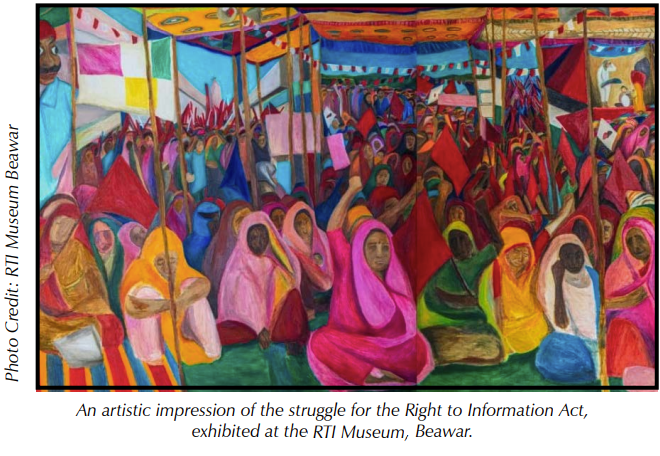
The RTI Mela 2025, held on 12th October 2025 at the RTI Museum site in Beawar, Rajasthan, marked the 20th anniversary of the Right to Information Act and celebrated three decades of struggle by the Mazdoor Kisan Shakti Sangathan (MKSS) and the people of Beawar. The event served as a vibrant platform for promoting transparency, accountability, and citizen empowerment through the effective use of RTI.
The mela witnessed enthusiastic participation from activists, community members, and organisations committed to strengthening democratic processes. Various stalls were set up to showcase initiatives and achievements under the RTI framework by a large number of organisations, including the School for Democracy, Peoples’ Union for Civil Liberties, Social SWRC Tilonia Barefoot College, National Campaign for Peoples’ Right to Information and Common Cause. The gathering included interactive sessions, cultural performances and discussions.


