
Workers’ Struggle for a Dignified Life
WAR FOR FAIR WAGES
Workers’ Struggle for a Dignified Life
Anumeha Yadav *
Noida, Uttar Pradesh: At 8 am, an hour before factories would start work. Maina Devi (workers’ names have been changed on request) waited for her company bus on the sidewalk next to a large warehouse in Phase 2 of Noida’s industrial area.
It had been a week since she and hundreds of workers from multiple factories on the borders of Delhi stopped work for four days protesting against low wages and difficult work conditions. Several factories still showed damage. Amid police presence and fresh notices on factory gates reassuring workers of revised wages, Devi was heading to work, her thumb in a fresh bandage.
Employed at Gurudas Amardas International Private Limited, that makes wire harness for automobiles and shielded cables used in automation and data communication, the migrant worker from Uttar Pradesh’s Moradabad, 160 km away from her factory, had punctured her left thumb the previous day while putting a wire on the terminal.
Despite the injury being extremely painful, Devi told The Migration Story that she had no choice but to go to work as she was supporting her three children and missing a day’s work would mean losing Rs 530.
The company had hired her on a monthly wage of Rs 11,313, which after the strikes is set to rise to Rs 13,690. Earlier, she had worked for two years in garment factories in the Noida hosiery complex. “They paid even lower, only Rs 9,000 rupees a month,” Devi said. “For two years, I stood daily at the table, cutting threads in 12 hour-long shifts and the company did not increase our wages by even one rupee.”
From 2024 to 2026, she had worked three to four hours overtime nearly daily, she added. For this, the company had paid her Rs 25 for every additional hour of work after the regular eight-hour shift. This was in breach of the law that requires an employer to pay at least twice the normal wage as overtime for each extra hour. But most employers do not pay this rate, she said.
“You must stand from 8 or 9 am to 9 pm every day. At the most, you go to the toilet as a break. But one must rush back from to the station. Otherwise, production targets, handling 40 to 50 pieces an hour, pile up and become impossible,” she recalled.
As per the Minimum Wages Act, State governments are mandated to revise the minimum wages every five years. But both Uttar Pradesh and Haryana governments, where workers in the industrial areas around the national capital went on large strikes in April, had not done so in over 10 years.
As per the Minimum Wages Act, State governments are mandated to revise the minimum wages every five years. But both Uttar Pradesh and Haryana governments, where workers in the industrial areas around the national capital went on large strikes in April, had not done so in over 10 years.
This status quo was disrupted when Devi and her co-workers joined hundreds of other workers in the industrial complex in Noida to protest against poor wages, long working hours, and extremely low overtime pay. Videos posted by the firm’s young workers recorded their colleagues in large numbers picketing the factory gate peacefully, while policemen in riot gear approached them carrying batons.
The protests resulted in the Uttar Pradesh government revising the base or minimum wage rate; the wages of most workers such as Devi were now set to rise from Rs 11,313 to Rs 13,690.
“Ho gaya sahi. Clear ho gaya sab (It got corrected. It was sorted),” said young women workers who had gathered around Devi.
A Decade of Stagnant Wages
In Noida Phase-II, the protests began on April 9 and from there spread across industrial belts in more than eight sites in NCR. As per labour activists’ estimates, the protests involved around 50,000 factory workers in Noida alone. Protests further spread among domestic workers and gig workers.
Uttar Pradesh, where Noida is located, had not increased minimum wages since 2012. The law requires that minimum wage be revised at least every five years.
Yogesh Kumar, an activist with Inqilabi Mazdoor Kendra, a non-registered organisation which aims to act as a labour collective for registered unions, said that the recent protests in Noida had followed a series of similar wage hike demands by workers of Honda automobile manufacturing plant in Haryana’s Manesar on April 2, 70 km from Noida.
“From Honda, it spread to nearby Munjal Showa Limited plant on April 4, then to Satyam Auto, Roop Polymers by April 6, and from there to garment companies such as Richa Global and Modelama by April 8,” said Kumar. “Workers came out of Richa Global’s three of six factories in Manesar. After they won a wage hike on April 9, workers of Richa Global factories in Noida – the same firm runs five factories in Noida – and workers of Mothersons Sumi Wiring (an automobiles sector firm) started asking for similar wage increase. This intensified April 13 onwards.”
Haryana announced a revision on April 9, 2026, after workers did a series of strikes and protests that spread from factory to factory in automobile, ancillary, and garment exports units in Industrial Model Town Manesar, near Gurugram.
The Haryana wage revision was done after nearly 11 years.
Even these revisions may not adequately address rising costs. For instance, accounting for price rise, as per the All India Consumer Price Index Numbers (for Industrial Workers), if a worker earned Rs 10,000 minimum wages per month in 2015, then to keep pace with inflation, the worker would need to earn Rs 15,466 per month in 2026.
But most Indian workers, even in the formal or organised sector, earn rock-bottom wages. An analysis in the Azim Premji University’s State of Working India Report shows that in 2015, 92% women and 82% men earned less than Rs 10,000 a month.
The minimum wage in Uttar Pradesh for unskilled work in 2015, was just Rs 9,078. Thus, the base minimum wage on which revisions occur are already very low. This is half of what the Seventh Central Pay Commission had recommended 10 years ago as a living wage.
Mass Strikes, Minor Relief
Following large scale protests for over three days that impacted vehicle movement on National Highway 9, Uttar Pradesh finally increased the minimum wages, to Rs 13,690 for “unskilled” category, that includes workers employed as helpers and thread-cutters.
Women workers spoke of minor relief after the mass strikes: “They have increased our overtime pay from Rs 30 to Rs 40 an hour,” said Diksha, a young woman worker in a refrigeration factory.
Most were hopeful that some improvement may follow by next month. “I worked for Rs 10,000 last year. Now, they are saying the company will pay us Rs 13,000, let us see,” said Kakoli, a worker from Kolkata, who works in Richa Global, one of Delhi-NCR’s biggest garment export factories with an annual turnover of over Rs 2,000 crore which works with global brands such as Zara and Marks and Spencer. The Centre of Indian Trade Unions (CITU), a national union affiliated with the Communist Party of India (Marxist), issued a statement on April 14 critiquing the government’s actions as too little, too late.
Haryana announced a revision on April 9, 2026, after workers did a series of strikes and protests that spread from factory to factory in automobile, ancillary, and garment exports units in Industrial Model Town Manesar, near Gurugram.
“The so-called wage increase is a sham – far below survival levels,” it noted. “Workers in Uttar Pradesh and Haryana are paid significantly less than in Delhi despite identical living costs. In the face of soaring inflation, the demand for a minimum wage of Rs 26,000 per month is not merely a demand but a necessity.”
On April 17, CITU general secretary Elamaram Kareem questioned the Uttar Pradesh police for arresting labour activists -- Noida police have arrested over 300 persons, including activists -- who had gone to meet the district magistrate of Gautam Buddha Nagar.. “It is a shocking repression,” he stated. “CITU Delhi State General Secretary Aniyan P.V., President Virender Gaur, were illegally detained by the police on April 17. Earlier, in the early hours of 16 April our district secretary, Ram Swarath, was similarly illegally detained.”
Diksha Singh, Assistant Commissioner of Police of Gautam Buddha Nagar, refused to comment on the arrests to The Migration Story. “All I can say is that the protests began at the hosiery complex and spread to other areas.” Diksha Singh said the protests were instigated by a handful of labour activists on WhatsApp.
‘We Cleared Our Own Path’
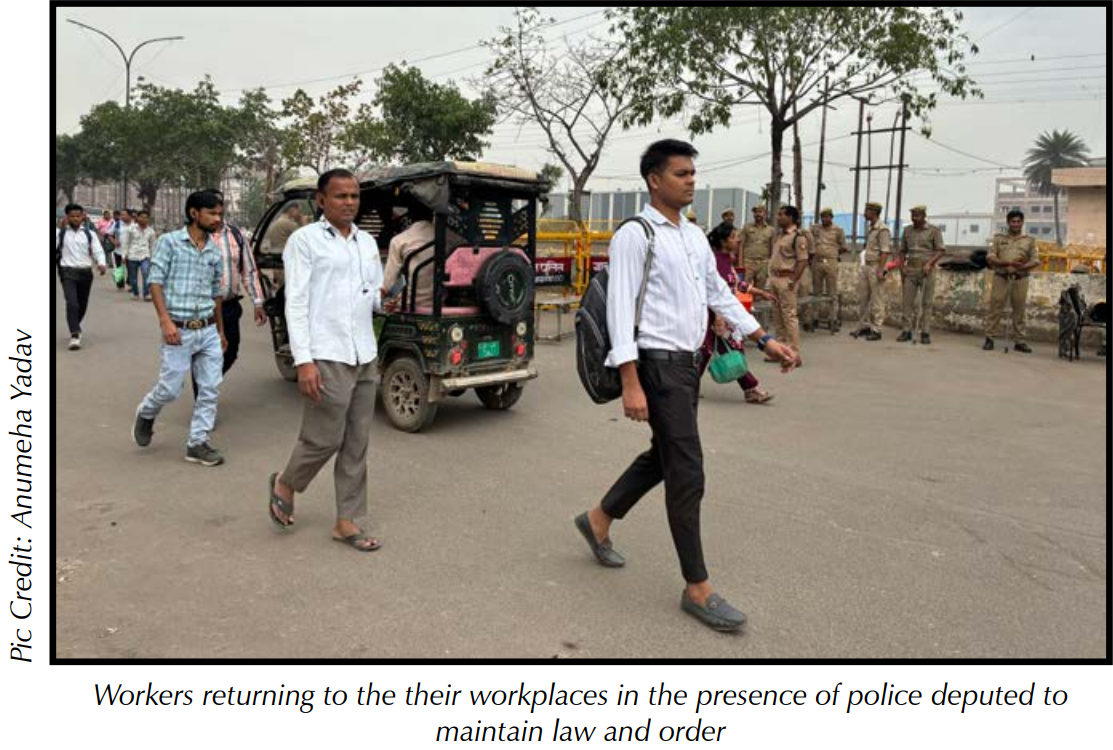
On April 17, a large number of policemen and industrial area securitymen continued to monitor road junctions. Several factories’ glass facades were broken because of stone pelting. Almost every factory gate now displayed prominent notice about wage increase in each grade of skills and for different categories of workers.
Sukhvarsha Projects Private Limited, a garment unit, employs over 100 workers and runs 24 hours in three shifts. Its workers said the intensity of the protests and the repression that followed may have come as a surprise to other city residents, but the conditions were building up for weeks.
“Why did the Uttar Pradesh government not increase the wage rate before the bawaal (chaos) ensued?” said Sushil Verma, a worker supervisor at the factory from Agra. “Why did the government take so many days after the Haryana government’s wage announcement? It is after the workers gathered, after the tod-phod (damage to factories) that the government took any initiative on our wages.”
Following large scale protests for over three days that impacted vehicle movement on National Highway 9, Uttar Pradesh finally increased the minimum wages, to Rs 13,690 for “unskilled” category, that includes workers employed as helpers and thread-cutters.
Outside Noida Electronics Company Limited, a worker from Agra said, “For some time now, there have been problems and wage theft has been going on. Workers slowed down work, thousands came out and finally agitated only to ask to correct this theft. This had to happen.”
(This article was first published by the Migration Story, India’s first newsroom to focus on the country’s vast internal migration population.)
The Writer’s Note—Action Still Awaited
The last three months – from March to May – northern India witnessed a range of protest actions, strikes, agitations by workers in the manufacturing sector, the causes and repercussions of which are still unfolding. After a series of protests at construction sites of large refineries in Barauni in Bihar and Sonipat in Haryana in late February, Manesar in Haryana on the outskirts of Delhi recorded a series of strikes by workers in the automobile and ancillary units, which in a matter of days had spread to workers of garment factories. From Manesar in Haryana, the strikes spread to Noida in Uttar Pradesh.
The protests in Noida intensified between April 8 and 18. More than 40,000 workers stopped work and came out on the streets demanding corrections in wages and better work conditions at 80 sites.
Most Noida workers said that the rising cooking gas prices for those lacking a gas connection – Rs 400 rupees for a kilo of LPG that barely lasts a family of three for three days – acted as a spark in a tinderbox.
On April 17, a large number of policemen and industrial area securitymen continued to monitor road junctions. Several factories’ glass facades were broken because of stone pelting. Almost every factory gate now displayed prominent notice about wage increase in each grade of skills and for different categories of workers.
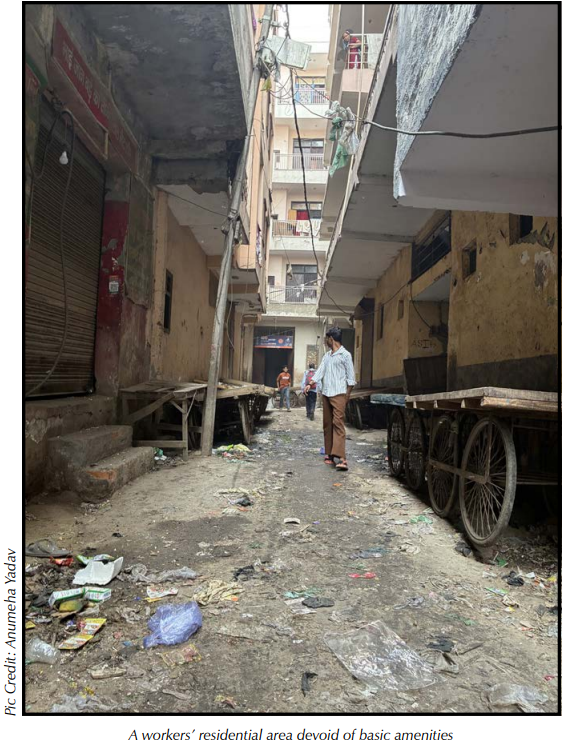
In Noida Special Economic Zone, the contrast of India’s growth story is stark. It boasts of top industrial infrastructure and accounts for over Rs 11,000 crore worth exports in 2025 covering engineering, garments and pharmaceuticals, but in Nayagaon, a few kilometers away, factory workers earn less than Rs 11,000 and live in congested tenements with inadequate sanitation. Delays or missing work leads to pay cuts. The rooms lack light and adequate ventilation and often have four to five inhabitants sharing one room for a rent of over Rs 5,000. Migrant workers are able to sustain themselves in the city on low wages only because of this duality of rural-urban existence, where the family in the village sustains on subsidised foodgrains.
Besides notices announcing minimum wages being revised after over a decade, from Rs 11,313 to Rs 13,690 for “unskilled” work and from Rs 13,940 to Rs 16,868 for “skilled” work such as stitching, several factories, including Mothersons Sumi Wiring and DLJM Pvt Ltd. an injection moulding firm, displayed communication trying to pacify workers. But it is still to be seen if employers and the government will implement it, say unions.
Even days later, when I visited, several factories’ glass facades remained broken in several places from stone pelting. Security guards working at the factories’ gates described heavy stone pelting in the area including at the police station. They said that last they had witnessed such scenes was during a labour agitation in Noida in February 2013. They described it having been more intense though shorter in length.
NEXT »


