
Common Cause Events
Participation in World Bank Group Country Partnership Framework Consultation
On 6 April 2026, Ms. Divya Singh Chauhan, Legal Officer, Common Cause, participated in a stakeholder consultation convened by the World Bank Group on its newly approved Country Partnership Framework (CPF) 2026–31 for India. The meeting brought together representatives from think tanks, civil society organisations, the private sector and the International Finance Corporation (IFC) to discuss the Framework’s priorities and implementation strategy for the next five years.
YLAC Stakeholder Consultation on Compensation for Wrongful Imprisonment in India
On 28 April 2026, Ms. Divya Singh Chauhan, Legal Officer, and Mr. Rishikesh Kumar, Research Executive (Legal) from Common Cause participated in a stakeholder consultation with fellows from the Young Leaders for Active Citizenship (YLAC) as part of its Policy in Action Program. The interaction was organised to support YLAC’s policy research on Compensation for Wrongful Imprisonment in India.
During the discussion, the Common Cause team shared insights on key challenges within India’s criminal justice system, including prolonged undertrial detention, the need to reinforce the principle that “bail is the rule, jail is the exception”. They also highlighted the importance of developing a comprehensive compensation framework that includes rehabilitation of those wrongfully imprisoned.
Panel Discussion on Strengthening Domestic Workers
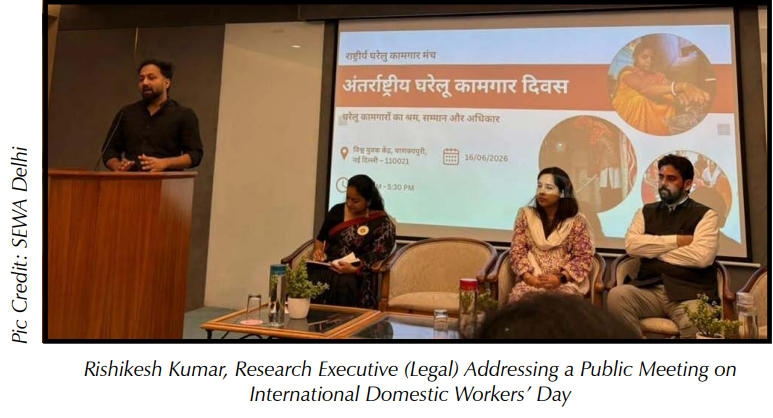
On 16 June, 2026, Common Cause Team participated in a panel discussion on the issues related to rights, dignity and legal protection of domestic workers on the occasion of International Domestic Worker’s Day. Rishikesh, Research Executive (legal) at Common Cause shared the perspective of the ogranisation. The event was organized by SEWA and was attended by well-attentive audience. The conversations highlighted a shared vision: a future where domestic workers are recognized as workers, their rights are protected, and they have access to dignified work, social security, and safe workplaces.
Editorial Meeting on Judicial Definition Project
On 28th April 2026, Radhika Jha from Common Cause attended the Editorial Committee Meeting of the Judicial Definitions Project. The meeting was held to discuss the activities within the Project in the recent few months and the course of action for the upcoming months. Outreach projects, adding localised state-wise knowledge and efforts towards scaling up the project were discussed.
Democratic Backsliding and Democratic Resilience
Common Cause Director, Dr Vipul Mudgal, spoke at an online event organised by the Carnegie Endowment for International Peace on June 16, 2026. The title was “Democratic Backsliding and Democratic Resilience.” Dr Mudgal spoke on the leading role civil society has played in India’s struggle to regain a stronger democracy. The event was organised in collaboration with the scholars at the Universities of Harvard, Stanford, Notre Dame, UPenn, UVA, and Cornell.
He said many civil society organisations in India have been working to restore citizens’ confidence in the Constitution and the rule of law. Working against all odds, some organisations have been focusing their energies on probity in public life, the rule of law, accountable governance, and free and fair elections. He said it was not the mandate of civil society to hold street protests or to participate in politics. However, they have been using awareness campaigns, public forums and the courts to meet their objectives.
Dr Mudgal cited many Public Interest petitions filed by Common Cause and the Association for Democratic Reforms (ADR), among others. He said many civil society organisations have been holding public hearings and documenting cases of egregious attempts at exclusion of citizens from public processes. He told the participants of the well-attended and interactive session that even though many PILs have not yielded the desired results, they have been able to expose questionable policies and create awareness around them. The other speakers included leading activists, journalists and human rights defenders.
The participants of the collaborative forum have been surveying existing literature and commissioning more to glean practical, concrete lessons practitioners can use to answer questions they are facing right now. This group of scholars is also working with pro-democracy actors in about a dozen countries to learn from their comparable situations. Some of these experiences offer useful lessons while others are cautionary tales. They are also in touch with Members of Parliament, judges, civil society leaders from across the political spectrum (such as the leader of Black Lives Matter in America), and top academics working on these issues.
The backdrop of the event was the fact that authoritarians around the world have been learning from and supporting one another. In recent years, freedom fighters living under dictatorships have banded together to fight back, collaborating with scholars to learn what techniques work against modern autocrats. The democracy activists aim to form a network of transnational relationships and real-time learning appropriate to the peril the world is facing.
The organisers believe that cross-border collaborations offer opportunities for democracy defenders to think strategically together about how to fight back in countries where democracy is being challenged. The democracy scholars believe that active citizens working together could materially change the outcome of this history
NEXT »


