
Domestic Work, Wages and Work Places
BEYOND THE PRIVATE SPHERE
Domestic Work, Wages and Collective Organising
Aditi Yajnik*
Domestic work has increasingly emerged as a significant source of employment for women across the world, particularly in urban and rapidly developing economies. As more households rely on paid assistance for caregiving, cleaning, cooking, and other forms of household maintenance, the demand for domestic labour has expanded considerably over the past few decades. At the same time, domestic work continues to remain one of the most informal and least regulated sectors of employment globally. Workers in this sector often face inadequate legal protections, low wages, long working hours, and limited access to social security or labour rights, largely because domestic work takes place within private households and is frequently excluded from formal labour frameworks.
Alongside the steady increase in the number of domestic workers worldwide, many have also observed a pronounced trend toward the feminisation of this workforce. Women constitute the overwhelming majority of domestic workers, reflecting broader gendered divisions of labour in society where care work and household responsibilities are traditionally associated with women. Economic inequalities, migration patterns, limited access to formal employment opportunities, and entrenched social norms have further contributed to the concentration of women in domestic labour. Consequently, domestic work has become not only a major avenue of female employment but also a site where issues of gender, class, migration, and labour rights intersect in complex ways.
Definitions and Classification
The United Nations’ International Standard Industrial Classification of All Economic Activities (ISIC)1 identifies domestic work within the industrial sub-category titled “Activities of private households as employers of domestic personnel” (commonly referred to as “private households with employed persons”). This classification seeks to formally recognise the economic activities carried out within households through the employment of domestic workers, including tasks such as cleaning, cooking, childcare, elderly care, gardening, driving, and other forms of household maintenance and caregiving labour. By placing domestic work within an internationally recognised economic classification framework, the UN acknowledges the sector as a significant component of labour markets and household economies rather than merely an extension of unpaid familial responsibilities.
The International Labour Organization (ILO), through its Domestic Workers Convention, 2011 (No. 189), provides a comprehensive definition of domestic workers. According to the ILO, a domestic worker is “any person engaged in domestic work within an employment relationship,” while “domestic work” itself refers to “work performed in or for a household or households.” This definition is intentionally broad and inclusive, encompassing workers employed on a full-time, part-time, temporary, live-in, live-out, or casual basis, provided that the work is undertaken as part of an employment arrangement. The ILO’s formulation is significant because it moves domestic labour out of the realm of invisibility and private obligation, recognising it instead as legitimate labour deserving of dignity, labour protections, fair remuneration, and social security rights comparable to those available in other sectors of employment.
Domestic work remains one of the most informal and least regulated sectors of employment globally. Workers in this sector often face inadequate legal protections, low wages, long working hours, and limited access to social security or labour rights.
Recent estimates by the ILO suggest that there are approximately 75.6 million2 domestic workers worldwide aged 15 years and above, making domestic work one of the largest sources of informal employment globally. The sector employs nearly three-fourths of the global domestic workforce.
Legal Battles and Home as a Place of Work
The State has historically demonstrated a persistent tendency to overlook and inadequately address the concerns and rights of domestic workers, resulting in their continued exclusion from comprehensive labour protections and welfare frameworks. One of the principal reasons for this neglect lies in the deeply informal character of domestic work itself. Domestic labour is typically performed within private households, often without written contracts, fixed working hours, standardised wages, or clearly defined employer–employee relationships. Because of this informality, domestic work frequently falls outside the conventional structures through which labour is regulated, monitored, and protected by the State. The absence of formal documentation and institutional oversight has made it difficult for governments to accurately recognise, record, and regulate the sector in the same manner as other forms of employment.
Another significant factor contributing to this longstanding neglect is the reluctance to acknowledge the household as a legitimate site of economic production and labour. Historically, home has been perceived as a private and personal sphere rather than a workplace subject to public regulation and labour standards. This public–private divide has allowed domestic work to remain largely invisible within legal and policy frameworks, despite its essential contribution to sustaining households and enabling broader economic productivity. Since domestic workers operate within intimate household settings, States have often hesitated to intervene, citing concerns over privacy and the sanctity of the home.
Private households culturally and historically have occupied an ambiguous position within labour and legal frameworks. Unlike factories, offices, or other conventionally recognised workplaces, the household has rarely been acknowledged as a formal site of employment, despite the fact that it is a space where labour is systematically performed in exchange for wages. A private household is a complex and deeply negotiated site of labour relations.
In the absence of formal contracts or institutional oversight, domestic workers are often compelled to negotiate directly with employers regarding wages, workload, working hours, leave, mobility, food, accommodation, and other conditions of employment. These negotiations are shaped not only by economic considerations but also by broader social hierarchies of gender, caste, class, ethnicity, migration status, and age. Since the workplace is simultaneously someone else’s home, domestic workers must navigate unequal power dynamics embedded within intimate and personal spaces. Employers frequently exercise control through paternalistic attitudes, emotional expectations, or informal arrangements that blur the boundaries between employment and familial obligation. Terms such as “part of the family” are often invoked to mask working conditions or to avoid recognising domestic workers as formal employees entitled to rights and protections.
According to the ILO, a domestic worker is “any person engaged in domestic work within an employment relationship,” while “domestic work” itself refers to “work performed in or for a household or households.”
The household as a workplace is distinct from most other labour settings because it combines intimacy with economic dependency. Unlike workers in factories or offices who operate within collectively regulated spaces, domestic workers are typically isolated within individual homes, making collective bargaining and unionisation particularly difficult. The invisibility of labour performed within households further contributes to the social and legal marginalisation of domestic workers. Yet despite these constraints, domestic workers continuously engage in everyday forms of negotiation and resistance, asserting claims to fair wages, dignity, rest, and humane working conditions.
In this sense, the household is not merely a passive site of employment, but also a contested social space where power, labour, gender relations, and ideas of care and servitude are constantly being negotiated and redefined.
The absence of formal documentation and institutional oversight has made it difficult for governments to accurately recognise, record, and regulate the sector in the same manner as other forms of employment.
Minimum Wages
Since the adoption of ILO’s Convention No. 189 on Domestic Workers in 2011, the struggle for the legal recognition and protection of domestic workers has gained significant momentum across many countries. Simultaneously, the growing assertion by domestic workers themselves as an integral part of the labour force has strengthened demands for greater visibility, labour rights, and state accountability.
However, the nature and impact of these efforts have varied considerably across different States and regions in India, shaped by local political priorities, labour regimes, and social attitudes toward domestic work. One important initiative undertaken in some States has been the inclusion of domestic workers within the ambit of minimum wage legislation. By recognising domestic work as wage labour deserving statutory remuneration, such measures represent an important step toward formalising the sector and addressing the historical undervaluation of domestic labour. At the same time, the implementation and enforcement of these protections continue to face significant limitations due to the informal and fragmented nature of domestic work.
The Minimum Wages Act empowers both the Central and State Governments to fix and periodically revise the minimum wages payable to workers, taking into account factors such as the nature and duration of work, the skill level required, and the basic living needs of workers, including considerations relating to calorific intake and subsistence requirements. At present, 14 States and Union Territories have minimum wages fixed for domestic workers.
Domestic work is not defined uniformly across State gazette notifications, and the scope of tasks recognised under the category varies considerably from one State to another. States such as Kerala, Karnataka, and Maharashtra adopt differing approaches in identifying the nature of domestic labour covered under minimum wage and labour notifications. While some States include a broader range of activities such as gardening, driving, watch and ward duties, or security-related services within the ambit of domestic work, others adopt a narrower understanding that largely confines domestic work to housekeeping, cleaning, cooking, and caregiving responsibilities. These variations reflect differing administrative approaches as well as broader social perceptions regarding what constitutes domestic labour. However, a large proportion of domestic work continues to be classified as unskilled labour, revealing the persistent undervaluation of household and care-based work despite the labour often involved in performing such tasks.
In this context, part-time domestic work, particularly by workers employed across multiple households, has become increasingly preferred among middle-class households. This preference is shaped by several economic and social factors, most notably the availability of relatively inexpensive labour and the flexibility such arrangements offer to employers. Unlike livein domestic work, part-time arrangements generally do not impose responsibilities relating to boarding, lodging, or longterm welfare obligations on employers. At the same time, this system shifts a significant degree of economic insecurity onto workers, who often depend on multiple employers and fragmented working hours to secure a sustainable income.
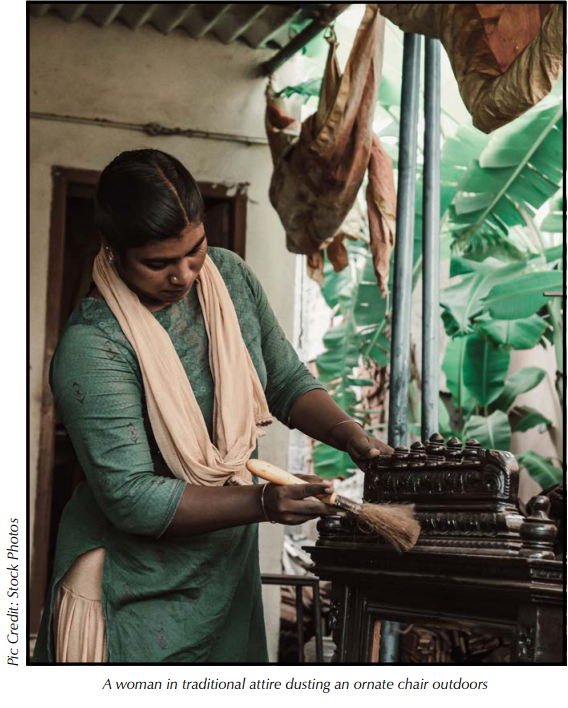
The State’s limited and often fragmented recognition of domestic work as legitimate labour is evident not only in the inadequate fixation of wages and uneven extension of labour protections, but also in the absence of clarity regarding fundamental conditions of employment such as working hours, overtime, and rest periods. Under minimum wage frameworks, the standard working day across sectors is generally understood to be eight hours. However, this framework inadequately captures the realities of domestic work. Live-in domestic workers, whose labour is deeply intertwined with the rhythms of the household, often remain available for work far beyond prescribed hours, making the distinction between working time and personal time increasingly blurred. Similarly, part-time domestic workers may spend less than eight hours in a single household, yet cumulatively work well beyond the standard workday across multiple employers. Despite this, the fragmented and dispersed nature of their labour frequently prevents their total working hours from being formally recognised within existing labour regulations.
Worker Collectives and Unions
The organisation of domestic workers through unions and workers’ collectives remains relatively limited, particularly when compared to more formal sectors of employment. This is largely due to the dispersed nature of domestic work, which takes place within private households and is often characterised by isolation, informality, and lack of fixed workplaces. The absence of a common physical site of employment makes sustained collective mobilisation difficult, while the diversity of working arrangements ranging from full-time live-in work to short-hour engagements across multiple households further fragments the workforce. Despite these structural constraints, various unions and grassroots collectives have emerged over time to organise domestic workers and advocate for their rights, marking an important shift in how this sector is politically and socially understood.
These unions have not only functioned as platforms for collective bargaining but have also served as alternative spaces of learning and empowerment. Through regular meetings, training sessions, and awareness campaigns, they have worked to help domestic workers recognise their labour as skilled, valuable, and deserving of fair remuneration. A central focus of such efforts has been to challenge the normalisation of underpayment and informal arrangements by fostering an understanding of “fair wage for fair work.” In doing so, unions have played a crucial role in shifting domestic workers’ self-perception from isolated individuals negotiating independently within households to members of a broader collective workforce with shared interests and rights.
In addition to worker education, unions and collectives have also undertaken outreach initiatives aimed at sensitising employers about the rights and entitlements of domestic workers. These campaigns often emphasise the importance of written agreements, regulated working hours, respectful working conditions, and timely payment of wages. By engaging directly with employers, these organisations attempt to bridge the gap between legal provisions and everyday practices within households, where informal norms often override formal labour standards.
The emergence of domestic workers as a distinct political and labour category has been shaped significantly through collective mobilisation and sustained organising efforts by unions, worker associations, and advocacy networks. Organisations such as the National Platform for Domestic Workers3 have played an important role in building nationwide campaigns demanding comprehensive and rightsbased legislation for domestic workers. These campaigns have sought not only legal recognition but also a broader transformation in how domestic work is socially and economically perceived. By foregrounding domestic workers as skilled and indispensable contributors to households and urban economies, such movements challenge the long-standing tendency to treat domestic labour as informal, naturalised, or merely supplementary work. At the centre of these struggles lies an important contradiction within contemporary labour structures. Campaigns for national legislation therefore seek to address this structural invisibility by demanding recognition of domestic work as legitimate labour deserving regulated wages, decent working conditions, and social protections comparable to those available in other sectors.
Despite structural constraints, various unions and grassroots collectives have emerged over time to organise domestic workers and advocate for their rights, marking an important shift in how this sector is politically and socially understood.
Conclusion
Domestic work continues to occupy an ambiguous and often contradictory position within contemporary labour systems. Despite the growing dependence of households and economies on domestic workers for care, cleaning, and other forms of (re)productive labour, the sector remains largely informal, weakly regulated, and insufficiently recognised within labour frameworks. The continued perception of the household as a private sphere rather than a legitimate workplace has contributed to the invisibility and systematic undervaluation of domestic labour, particularly that performed by women from marginalised social and economic backgrounds.
At the same time, increasing mobilisation by domestic workers through unions, collectives, and rightsbased campaigns has challenged these long-standing exclusions and asserted domestic work as dignified labour deserving fair wages and legal protection. Initiatives such as the inclusion of domestic workers within minimum wage frameworks and the creation of worker-led wage rate charts represent important efforts toward recognising and valuing domestic labour. In this context, the regulation of paid care and household work is not merely a question of labour policy, but one that carries broader implications for social justice, gender relations, and the reorganisation of care within society.
References
- NEETHA, N. (2013). Paid Domestic Work: Making Sense of the Jigsaw Puzzle. Economic and Political Weekly, 48(43), 35–38. http://www.jstor.org/stable/23528837
- GOTHOSKAR, S. (2013). The Plight of Domestic Workers: Confluence of Gender, Class and Caste Hierarchies. Economic and Political Weekly, 48(22), 63–75. http://www.jstor.org/stable/23527913
- International Labour Organization. (2011a). Convention No. 189: Decent work for domestic workers. https://normlex.ilo.org/dyn/nrmlx_en/f?p=NORMLEXPUB:12100:0::NO::P12100_ILO_CODE:C189
- National Platform for Domestic Workers. (n.d.). Facebook page. Retrieved April 29, 2026, from https://www.facebook.com/ationalPlatformForDomesticWorkers
NEXT »


