
BANKS ARE THE FIRST LINE OF DEFENCE
BANKS ARE THE FIRST LINE OF DEFENCE
Better Inter-Agency Coordination Needed
India is writing a new chapter in digital finance. Since its launch in 2016, UPI has grown from 1.78 crore transactions to over 24,162 crores in FY 2025-26, worth about Rs 314 lakh crore, and now runs across 741 banks (PIB, 2026). The IMF recognises it as the world's largest real-time payment system.
But there is a worrying side to
this story: Digital safety has not kept pace.
Between 2021 and 2025, the National Cybercrime Reporting Portal (NCRP) recorded more than 65.89 lakh financial fraud complaints, with reported losses of over Rs 55,050 crore. Only about Rs 8,189 crore was marked as lien, and just over 1.95 lakh FIRs were registered (I4C, NCRP & CFCFRMS data).
A single phone call. A link that looks like it came from your bank. A payment request you didn't expect. In India today, these small moments are where cybercrime begins, and they can end with a lifetime of savings gone in minutes.
Over the past decade, cybercrime has become part of everyday life in India, touching people's money, their data, and their sense of safety online. It spares no one: Anyone with a phone, a bank account, or a social media profile is at risk. What began as scattered, individual acts of fraud, has now grown into a highly organised ecosystem, with networks that operate across state lines, target victims across communities, and exploit gaps between institutions.
At the centre of this ecosystem sits one critical player, the bank. Money lost to fraud almost always travels through bank accounts, which makes banks both the first line of defence and the most important point of intervention. Yet no bank can tackle this alone. Criminals move fast across jurisdictions, while institutions often respond in silos.
This article draws on the key findings of the Status of Policing in India Report 2026: Cybercrime—Victim Experiences and Systemic Responses report to examine the role of banks in the fight against cybercrime, and why stronger coordination between banks, law enforcement, regulators, and other institutions is essential to stopping fraud before the money disappears.
Complaints to the Bank
The rapid escalation of cybercrime in India has underscored the need for a systematic response mechanism, including prompt reporting of cyber fraud to banks by victims. Over half of the victims of digital financial fraud (52 per cent) reported lodging complaints independently with the bank. In contrast, four
in ten of those who aided or helped a victim of cybercrime
(41 per cent) reported that a complaint was filed separately with the bank. At the same time, over two-fifths of the victims (44 per cent) and close to half (47 per cent) of those who assisted the cybercrime victims did not file a separate complaint with the bank.
To understand reporting behaviour across socio-economic groups, the responses were analysed by the economic class of the victims. The data reveals a clear class-based pattern in complaint behaviour. Respondents from rich economic backgrounds show the highest likelihood of filing complaints with banks (63 per cent), compared to other income groups. In contrast, the most economically disadvantaged (43 per cent) and those from lower income brackets (50 per cent) were less likely to complain to the bank separately.
Recovery of Money
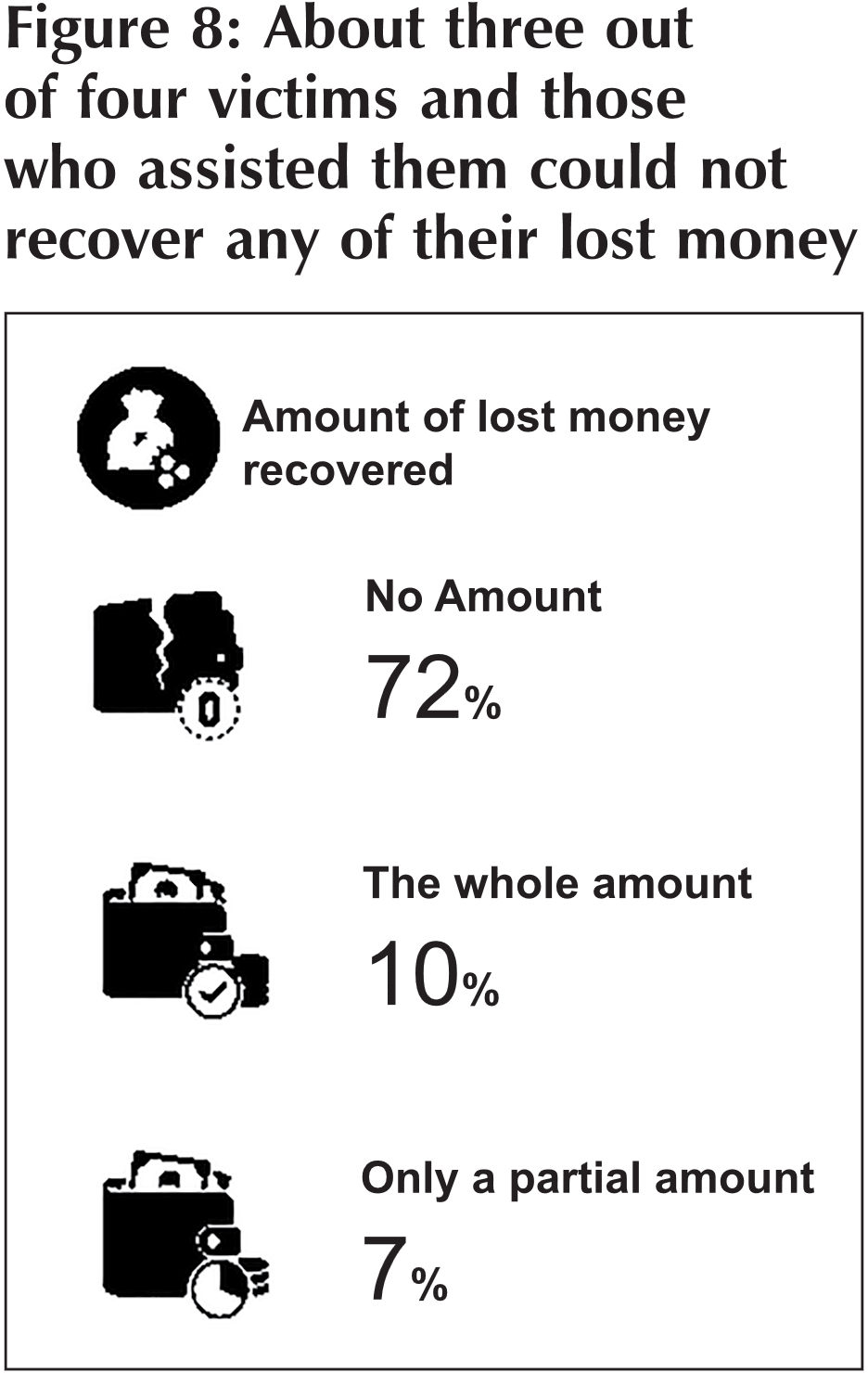
Recovering lost money is a key measure of how well cybercrime response systems work. Among victims of digital financial fraud and those who assisted them, 72 per cent reported that none of their lost money was recovered (Figure 8). Only one in ten said the full amount was recovered, and 7 per cent recovered a partial amount, so just 17 per cent recovered their money fully or partially. Overall, the vast majority of victims received little or no restitution, meaning meaningful recovery was not achieved.
Victims’ experiences with cyber fraud resolution are not only shaped by whether they recovered their lost money, but also by how quickly the recovery takes place. The time taken to restore funds can significantly influence victims’ perceptions of the effectiveness of institutional response mechanisms. The data indicates that financial recovery, when it occurs, tends to happen relatively early for a significant proportion of victims. Nearly a third of the victims and those who assisted cybercrime victims (32 per cent) reported recovering their money within 15 days of the incident, while 17 per cent were able to recover the amount within 16 to 30 days. About a quarter (24 per cent) reported that they were able to recover their money between one to two months, and one in ten said that it took more than two months to recover their money.
Institutional Response and Effectiveness
Victims of cybercrime approach several institutions in seeking resolution, among them banks and regulators such as the RBI and the Banking Ombudsman. How they rate these institutions can differ widely, depending on the nature of their interaction and how effective the response was.
Banks are often the first point of contact, yet their performance receives mixed reviews. On their role in recovering lost money, 32 per cent of digital financial fraud victims and those who assisted them were satisfied (11 per cent very satisfied, 21 per cent somewhat satisfied), while 38 per cent were dissatisfied (16 per cent somewhat dissatisfied, 22 per cent very dissatisfied). Notably, one in four (24 per cent) said they never used this service.
Regarding the RBI Banking Lokpal mechanism, a little over a quarter of respondents (27 per cent) were satisfied (9 per cent “very satisfied”, 18 per cent “somewhat satisfied”), while one in five (20 per cent, combining “somewhat” and “very dissatisfied”) were dissatisfied. A striking 46 per cent said they had never used the Lokpal services. One possible reason is limited awareness among victims that the RBI Banking Lokpal mechanism exists.
Bank-Police Coordination and Victim Satisfaction
Coordination between banks and the police is central to complaint redressal in financial cybercrime. Although systems such as the Indian Cyber Crime Coordination Centre (I4C) are meant to ensure seamless coordination, significant gaps remain in practice, making redressal harder for victims. The survey reflects this, with many victims and those who assisted them reporting low satisfaction.
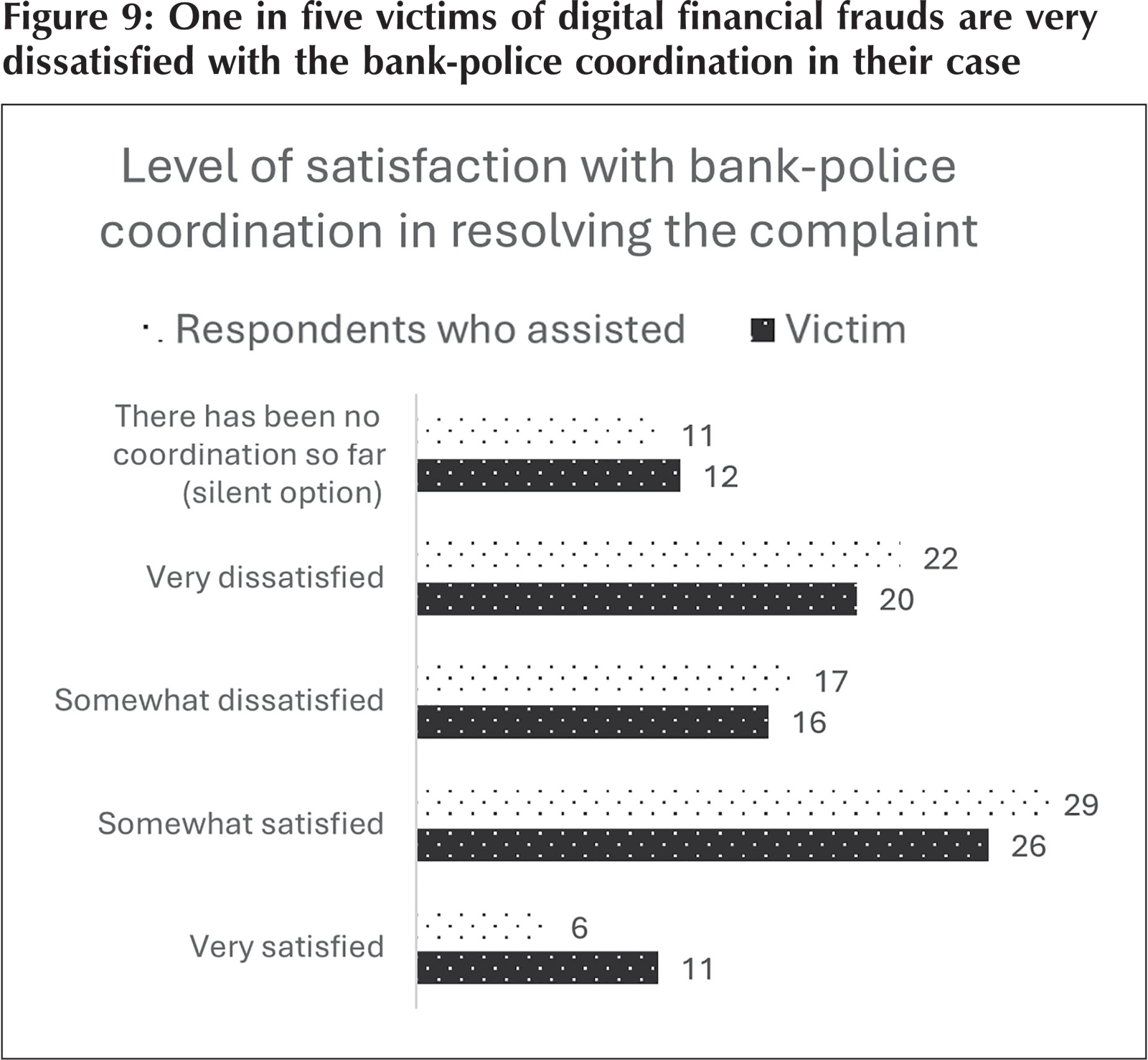
Figure 9 shows mixed satisfaction in both groups. While 11 per cent of victims were "very satisfied," the share fell by nearly half, to 6 per cent, among those who assisted victims, though overall satisfaction was similar (37 per cent and 35 per cent). Meanwhile, 20 per cent of victims and 22 per cent of those who assisted were "very dissatisfied”, and 16 per cent and 17 per cent respectively were "somewhat dissatisfied." Over one in ten respondents in both groups said there had been no coordination between the bank and the police.
Satisfaction also varied with the recovery of money. Among those who recovered the full amount, 49 per cent were "very satisfied", 43 per cent were "somewhat satisfied", and none were "very dissatisfied”. Those with only partial recovery reported more mixed experiences: Just under one in five (17 per cent) were "very satisfied", while more than half (54 per cent ) reported being ”somewhat satisfied”, with a small share expressing dissatisfaction (20 per cent – 7 per cent ”very dissatisfied” and 13 per cent “somewhat dissatisfied”).
Conclusion
This article examined how banks and regulatory institutions respond to cybercrime victims and how satisfied victims are with that response. The findings show a banking system that is only partially functional, accessible to some, and uneven in its effectiveness.
Although many victims engaged with their banks and lodged complaints, this did not translate into meaningful recovery. Nearly two-thirds reported the fraud within 24 hours, and nearly half had their bank accounts frozen after complaining. Yet a vast majority recovered nothing, and recovery was slow for those who did, except for a third who recovered their money within 15 days. Wealthier and rural victims were more likely to complain to banks.
Satisfaction with the bank's role in recovering money and with the RBI Banking Lokpal is tepid, with around three in ten satisfied and a similar share dissatisfied. A significant share never sought the bank's help in recovering money (24 per cent), and an even larger share never accessed the RBI Lokpal (46 per cent). Victims whose money was fully recovered were more likely to be satisfied with the bank's role.
Seamless bank-police coordination is also essential to effective resolution. About a third of both victims and those who assisted them were satisfied with this coordination, though a slightly higher proportion were dissatisfied.
July September 2026